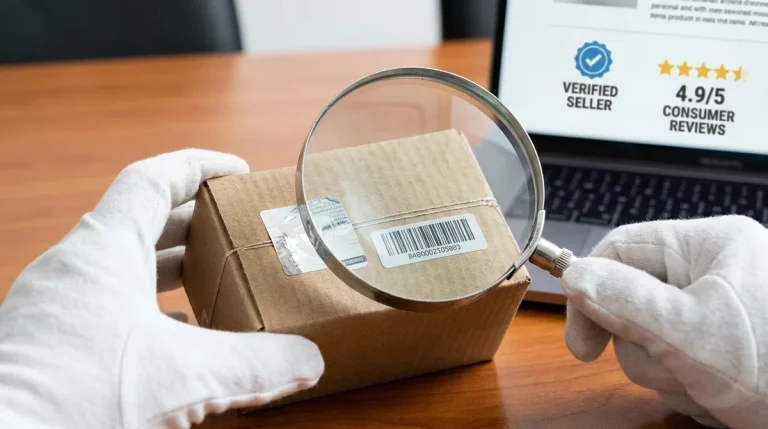


The most common online shopping scams are fake shops, social media ads for goods that never arrive, marketplace sellers who ask for payment outside the platform and fake delivery messages. In the US, these scams can be reported to the FTC, and in England, Wales and Northern Ireland to Report Fraud, the City of London Police service that replaced Action Fraud.
Table of Contents5 sections
This page gives general consumer information. Reporting routes and rules differ by country, so check your local consumer agency or police service for the steps that apply where you live.
What Is an Online Shopping Scam?
An online shopping scam is any trick that takes a shopper’s money or personal details in exchange for goods that are fake, never sent or never existed. Some scams aim at the payment itself, while others try to collect card details or account passwords for later use.
Scammers often copy the look of real brands and shops, so a scam site or message can appear convincing at first glance.
What Are the Most Common Online Shopping Scams?
The most common online shopping scams are fake shop websites, social media ad scams, marketplace payment scams, fake delivery messages and non-delivery with fake tracking, and the same tricks appear in many countries.
Fake shop websites
A fake shop looks like a normal online store, often with big discounts and a professional design. The goods either never arrive or turn out to be cheap copies. The web address may be a small misspelling of a well-known brand.
Social media ad scams
Ads on social platforms promote heavily discounted products, often clothing, electronics or toys. Clicking through leads to a shop that takes payment and then disappears.
Marketplace payment scams
On second-hand and classified marketplaces, a seller may ask the buyer to pay by bank transfer or a payment app outside the platform, which usually removes the platform’s own buyer protection. Some scams target sellers instead, with a “buyer” who claims to have overpaid and asks for the difference back.
Fake delivery messages
Texts or emails claiming that a parcel is waiting and a small fee is due often lead to a fake page that asks for card details. They work because many people are expecting a delivery at any given time.
Non-delivery with fake tracking
Some sellers send a real-looking tracking number that never updates, or that shows delivery to a different address, to delay complaints until it is too late to act.
What Are the Warning Signs of a Shopping Scam?
The clearest warning signs are pressure to act fast and requests for unusual payment methods. The FTC says scammers often want people to act before they have time to think, and often ask for payment by cryptocurrency, wire transfer, payment apps or gift cards.
Other common signs include:
- prices far below what every well-known retailer charges
- no clear business address, phone number or returns information
- a website that was set up very recently or has spelling mistakes in its name
- reviews that all appear at once, or that are copied from other sites
- messages asking for card details, one-time codes or passwords to “confirm” an order
- a seller who refuses to use the marketplace’s own checkout
A real business gives people time to decide. Countdown pressure combined with a request for an unusual payment method is a strong sign that something is wrong.
What Do People Usually Do Straight After a Shopping Scam?
Contacting the bank or card provider quickly is usually the first thing people do after paying a scammer, because each provider has its own process and time limits for disputes. Those time limits are the main reason speed matters at this stage.
Saving the evidence helps too. That includes screenshots of the website or advert, order confirmations, messages with the seller and payment records. If a password or one-time code was shared, changing the password on that account and any account that uses the same one is a common precaution.
Screenshots taken before a report is made are often the most useful evidence, since scam sites and adverts tend to disappear quickly.
Where Can Online Shopping Scams Be Reported?
In the US, shopping scams can be reported to the FTC and the FBI’s IC3, in England, Wales and Northern Ireland to Report Fraud, and in Scotland to Police Scotland on 101; reports help authorities spot patterns and shut sites down. The main routes in the US and the UK are shown below.
| Where | Service | What it handles |
|---|---|---|
| United States | FTC, at ReportFraud.ftc.gov | Scams, fraud and bad business practices |
| United States | FBI Internet Crime Complaint Center (IC3), at ic3.gov | Internet crime, including online fraud and scams |
| England, Wales and Northern Ireland | Report Fraud, at reportfraud.police.uk or 0300 123 2040 | Fraud and cyber crime; replaced Action Fraud from 4 December 2025 |
| Scotland | Police Scotland on 101 | Fraud and cyber crime in Scotland |
| UK | Forward suspicious emails to [email protected] | Phishing emails, checked by the National Cyber Security Centre |
| UK | Forward suspicious texts to 7726 | Scam texts, reported free to the mobile network |
The platform where the scam appeared, such as a social network or marketplace, also has its own reporting button for fake ads, shops and sellers.
One more warning comes from the FBI’s IC3, which says it does not work with organisations outside law enforcement to recover lost funds and will never contact people directly asking for money. Messages offering to “recover” money lost to a scam, for a fee, are a common follow-up scam.
Rules and reporting services differ by country and can change, so the local consumer agency or police service is the right place to confirm the current route.