
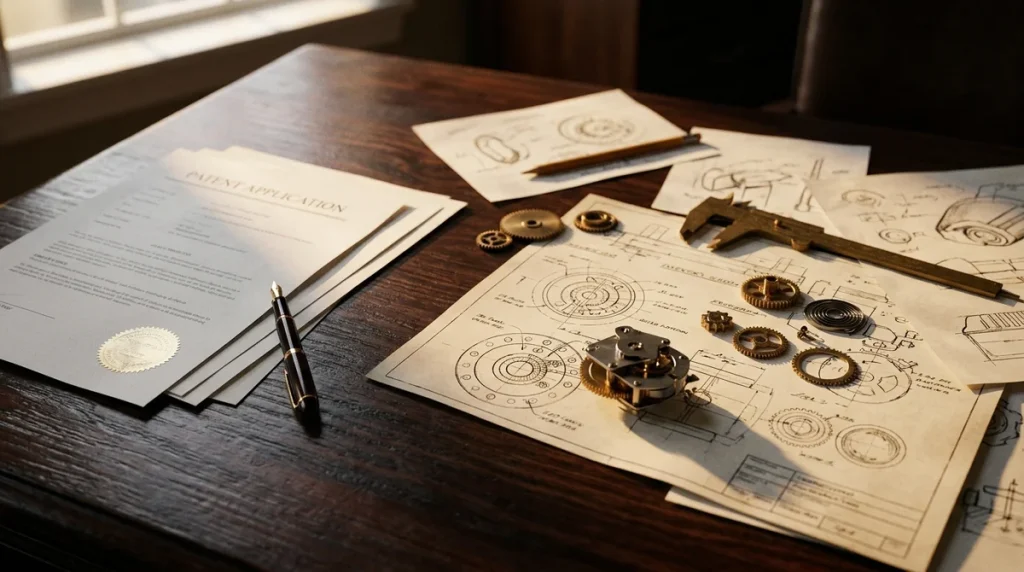
A trademark protects a brand name or logo, copyright protects creative work such as writing, music and photos, and a patent protects an invention. They often appear together on one product, but each covers a different part of it.
Table of Contents6 sections
This page is general information about how these rights work, not legal advice. Rules differ by country, so the official intellectual property office in each country is the place to check details.
What Is the Difference Between a Trademark, Copyright and a Patent?
A trademark protects brand names and logos and starts through use, copyright protects original creative work and starts automatically, and a patent protects inventions and starts only once it is granted. The table gives the short version for the US and the UK, based on the official offices in each country.
| Point | Trademark | Copyright | Patent |
|---|---|---|---|
| Protects | Names, logos, slogans and other signs that identify a brand | Original creative works, such as books, music, art, photos, films and software code | New, useful inventions, such as machines, processes and products |
| Everyday example | The brand name on a pair of trainers | The song in an advert | The way a new kind of zip works |
| How it starts | Through use, with stronger rights from registration | Automatically, once the work is created in a fixed form | Only after an application is examined and granted |
| How long it lasts | Can continue as long as it is used and renewed | US: usually the author’s life plus 70 years. UK: 70 years after the author’s death for written, musical and artistic works | Up to 20 years for most patents in the US and UK |
| Official office | USPTO (US), Intellectual Property Office (UK) | US Copyright Office (US). No register in the UK | USPTO (US), Intellectual Property Office (UK) |
Each one is explained in a little more detail below.
What Does a Trademark Protect?
A trademark protects the signs that tell shoppers who made a product or provides a service. The USPTO describes a trademark as any word, phrase, symbol, design or combination of these that identifies goods or services and sets them apart from others.
Registration is optional in the US, according to the USPTO. Rights can start simply by using a mark, but those rights are limited to the area where the goods or services are offered, while federal registration gives wider protection. The USPTO notes that TM or SM can be used before registration, and the ® symbol is used once a mark is registered.
A US registration can stay in force for as long as the owner keeps filing the required documents: one between the fifth and sixth years, and renewals every 10 years after that. In the UK, GOV.UK says a registered trade mark lasts 10 years and can be renewed every 10 years.
What Does Copyright Protect?
Copyright protects original creative work, such as books, articles, songs, photos, paintings, films and computer code. The US Copyright Office says a work is protected the moment it is created and fixed in a tangible form, for example written down, saved as a file or recorded.
Copyright does not protect facts, ideas, systems or methods of operation, according to the US Copyright Office. It protects the particular way an idea is expressed. Two people can write about the same historical event, but neither can copy the other’s actual text.
Registration with the US Copyright Office is voluntary. In the UK there is no copyright register at all, and GOV.UK confirms that protection is automatic.
How long it lasts depends on the type of work and the country:
- US works created from 1978 onwards: the author’s life plus 70 years.
- US works made for hire: 95 years from first publication or 120 years from creation, whichever ends first.
- UK written, dramatic, musical and artistic works: 70 years after the author’s death.
- UK broadcasts: 50 years after first broadcast.
What Does a Patent Protect?
A patent protects an invention, giving the owner the right to stop others from making, using or selling it for a limited time. Unlike copyright, a patent never happens automatically.
The USPTO says a utility patent can cover a new and useful process, machine, manufacture or composition of matter, or an improvement to one. The invention has to be new, useful and not obvious. Laws of nature, physical phenomena and abstract ideas cannot be patented.
In the US, utility patents last up to 20 years from the filing date, and design patents last 15 years from the date they are granted. In the UK, GOV.UK says a patent lasts up to 20 years and has to be renewed every year to stay in force, and some things are excluded, such as a way of doing business or playing a game.
Can One Product Have All Three?
Yes, one product can carry a trademark, copyright and patents at the same time. Each covers a different part of it.
Take a smartphone. The brand name and logo are trademarks. The written manual, the on-screen artwork and the software code are covered by copyright. Technical inventions inside, such as a new battery design, may be patented.
A logo can also fall under both copyright and trademark. The drawing itself is a creative work, while its use on products identifies the brand.
What Are Some Common Myths About These Rights?
Four myths come up often in everyday conversation about brands and creative work: that anything posted online is free to use, that the ® symbol can go on any brand name, that an idea can be copyrighted and that a renewed patent lasts forever. The official offices make each of these points clear.
- Myth: anything posted online is free to use. Copyright applies automatically, so online photos and text are usually protected even without a notice.
- Myth: the ® symbol can go on any brand name. The USPTO links ® to federally registered marks, and GOV.UK describes it as a sign of a registered UK trade mark.
- Myth: an idea can be copyrighted. Copyright covers the expression of an idea, not the idea itself.
- Myth: a patent lasts forever if it is renewed. Patents in the US and UK have a maximum term of about 20 years for most inventions.
Rules differ by country and change over time. For anything beyond general information, the official office in the relevant country, such as the USPTO, the US Copyright Office or the UK Intellectual Property Office, is the place to check.