

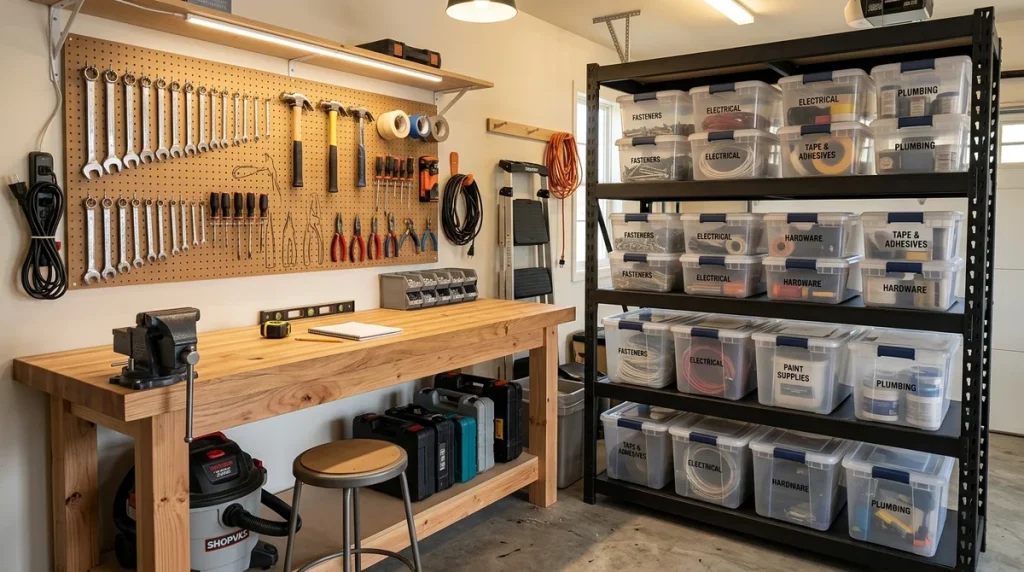
To organise a garage, empty it completely, sort everything into keep, donate and throw away, clean the empty space, then put things back in zones, with the heaviest items low and everyday items closest to the door. Getting things off the floor with wall shelves and hooks frees the most space. Plan a full weekend for a crowded garage, and keep safety in mind when you store fuel, paint and chemicals.
Table of Contents8 sections
Step 1: Pick a Weekend and Gather Supplies
Set aside a clear block of time and gather everything you need first, because a garage clear-out goes faster that way. A dry weekend is ideal, because most of the contents will sit on the driveway while you work.
Have these ready before you start:
- Heavy-duty bin bags and boxes for donations
- Labels and a marker
- A broom, dustpan and a bucket of soapy water
- Work gloves and sturdy shoes
- A tape measure and notepad for planning storage
Step 2: Empty the Garage and Sort Everything
Take everything out, so you can see exactly what you have and how much space there really is. Sort items into three groups as they come out: keep, donate or sell, and throw away or recycle. For homeowners preparing their garage for a major move or renovation, arranging vehicle transportation in advance can make the process easier, and reliable Kansas Car Shipping services can help relocate vehicles conveniently while freeing up valuable garage space.
Ask two questions about each item. When did you last use it? And does it need to live in the garage, or would it be better somewhere else in the house? Duplicates, broken tools and things you kept “just in case” years ago usually go first.
Old paint, chemicals and batteries
Don’t put old paint, motor oil, weedkiller, batteries or other chemicals in the household bin. The US Environmental Protection Agency (EPA) lists paints, cleaners, oils, batteries and pesticides among products that can contain hazardous ingredients, and advises reading the label for disposal directions. Many local councils run household waste sites that accept them, and some garages accept used motor oil for recycling.
Step 3: Clean and Check the Empty Space
Sweep the floor, brush down cobwebs, and wash oil stains with hot soapy water while the garage is empty, because that is the best chance to clean and spot problems.
Look for damp patches, roof leaks, cracks or signs of pests, and sort these out before anything goes back in. Check that the electrical panel or consumer unit, if it’s in the garage, and the path of the garage door are clear. Anything stored in front of the fuse box makes it hard to reach in a hurry.
Step 4: Plan Zones Before You Buy Storage
Divide the garage into zones based on how you use it, then measure each wall. Common zones include:
| Zone | What goes there | Where to put it |
|---|---|---|
| — | — | — |
| Everyday | Bikes, shoes, recycling, dog lead | Nearest the house door or the main door |
| Garden | Tools, hose, pots, compost | Near the outside door |
| Tools and DIY | Hand tools, drill, screws, workbench | Along one wall with good light |
| Car care | Cleaning products, screen wash, tyre pump | Near the parking space |
| Seasonal | Decorations, camping gear, winter tyres | High shelves or overhead racks |
| Chemicals and fuel | Paint, fuel, weedkiller | A separate locked cabinet or high shelf away from heat |
Leave enough clear floor to park or walk safely, and to open car doors without hitting shelves.
Step 5: Get Things Off the Floor
Wall storage frees the most floor space in a garage. Use the height of the walls before you think about cabinets.
- Shelving units: sturdy metal or wooden shelves for boxes and bins. Put heavy items on the lowest shelves.
- Pegboard or slat wall: for hand tools you use often, so every tool has a visible place.
- Hooks and brackets: for bikes, ladders, hoses and garden tools with long handles.
- Clear, labelled bins: for small items and seasonal gear, so you can see inside without opening every box.
- Overhead racks: for light, rarely used items, such as decorations.
Fix shelving to the wall
Anchor tall shelving units and cabinets to the wall. The US Consumer Product Safety Commission (CPSC) advises anchoring all furniture with drawers, doors and shelves to prevent tip-overs, and a loaded garage shelf is heavy. Fix brackets into studs or masonry with the right fixings, using a detector first to avoid hidden cables and pipes.
Check the weight rating of overhead racks and ceiling storage, and don’t exceed it. If you aren’t sure the ceiling or joists can take the load, ask a builder or joiner before fitting heavy overhead storage.
Step 6: Store Fuel, Paint and Chemicals Safely
Store flammable and hazardous products carefully, because a garage often holds both these products and sources of heat. Follow these rules:
- Keep products in their original containers with the labels on. The EPA advises never storing hazardous products in food containers and never mixing them.
- Store fuel only in approved fuel containers. The US Fire Administration advises never storing materials that can cause a fire in the sun or near an open flame or heat source. In a garage, that means keeping fuel well away from any boiler or water heater.
- Fill or pour fuel outdoors in the open air, never inside the garage or shed, and keep containers tightly sealed. Hampshire & Isle of Wight Fire and Rescue Service gives this advice.
- Check the limit on how much petrol you may keep at home. The same fire service says that in the UK you can store up to 30 litres without notifying your local Petroleum Enforcement Authority. Other countries set their own limits, so check with your local fire service.
- Keep chemicals out of reach of children, ideally in a locked cabinet or on a high shelf.
Never run a car or a generator inside an attached garage, even with the door open. The US Centers for Disease Control and Prevention (CDC) warns that this can cause carbon monoxide poisoning.
Step 7: Put Everything Back by Zone
Return items zone by zone, starting with the largest and heaviest. Store the things you use every week at waist to shoulder height, and push rarely used items higher or further back.
Use a stepladder, not a chair or a stack of boxes, to reach high shelves, and set it on firm, level ground. Ask someone to steady it when you carry bulky boxes up.
Label shelves and bins as you go. Labels make it easier for everyone in the house to put things back in the right place, which is what keeps a garage tidy.
How to Keep the Garage Organised
A garage stays organised when everything has a home and you reset it regularly. Take 15 minutes at the end of each month to put stray items back and clear anything that has built up on the floor.
Twice a year, at the change of seasons, swap seasonal items between the high shelves and the everyday zone, and do a quick sort for things you no longer use. A short regular reset is far easier than another full weekend clear-out.